
Natural Land Institute’s Legacy Tree Program announces the April 2025 Tree of the Month is a Yellow Birch (Betula alleghaniensis), a State Champion at the Stephenson County Historical Society Museum and Arboretum, (in Freeport, IL, 1440 S. Carroll Avenue.) It was nominated by Mark Luthin, who grew up in Freeport and now resides in Belvidere, IL. Luthin, a Board Trustee of Natural Land Institute, brought this special tree to the attention of NLI’s Executive Director Alan Branhagen and took him to see it.
This Yellow Birch was first listed on the Illinois Big Tree Register in 1983. It was last measured in 2022 and had a circumference of 6.5 feet, a height of 61 feet, and average crown spread of 38.5 feet.
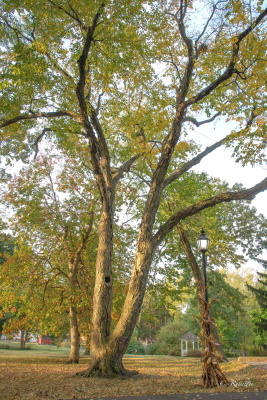
“A magnificent tree, the Yellow Birch is native in Northeastern North America including northern Illinois, where the tree is very rare,” said Branhagen. “Most people think of beautiful bark as the ornamental appeal of a birch tree. This one has exfoliating bark that is coppery or silvery, depending on whether it is wet or dry.”
This tree is one of many unique and historic trees planted by Oscar Taylor, on the grounds of his estate on the east side of Freeport. Taylor and his wife, Malvina, were early pioneers in Freeport. They quickly accumulated wealth, and in 1857 they built their large, stone, Italianate home on 14 acres of land, just outside the City. The land was probably part of the original prairie; stories later report the land was barren when they first moved in. The only tree was one lone apple tree.
Malvina and Oscar got to work quickly planting trees and gardens. They had a lifelong love of nature. Later on, one of their daughters, Winnie, gave the estate the name of “Bohemiana,” to express their love of nature and art. The Taylor family continued living in the house until the last Taylor inhabitant–granddaughter Elsie Maynard–passed away in 1943. In 1944, Oscar Taylor’s grandsons offered the house and five acres to the newly-formed Stephenson County Historical Society. The museum opened in October of 1944 and has been in continuous operation since.
Branhagen noted, “Yellow Birch has fine twigs that contain oil of wintergreen. If you scratch the stems, you will smell the same oil that is in Wintergreen Lifesaver candies This was used as flavorings for beverages, including root beer.”
The fast-growing Yellow Birch is long-lived with sturdy branching. Its bark is not as showy as white paper birches or flaky river birches, but it can be planted in combination with those two species for a very dramatic look. All birches have some of the highest wildlife value in native trees (after our oaks), as they host a high diversity of insects. Birch seeds are relished by many songbirds, including Goldfinches, Pine Siskins, and in wintertime a favorite of Redpolls that occasionally winter this far south.
Yellow Birch blooms in spring, the tree draped with strings of golden catkins (the male flowers) and shorter female catkins that become the thimbles of tiny winged seeds. The flowers are actually quite interesting, but not as showy as a Redbud or Crabapple in bloom. Fall color on Yellow Birch is a consistent fine yellow, adding to the tree’s ornamental appeal.
The tiny seeds rain down in winter, most noticeable when they land on snow like tiny, brown flakes. They require a moist, bare area to germinate. Yellow Birches often germinate on a log or stump in the wild, where they grow and develop roots into the ground becoming a unique-looking, stilt-like tree–after the wood they germinated on rots away. They can also germinate on mossy rocks and cliffs showing their beautiful root systems as they age.
Visit this tree and the Perennial Plant Sale held at the Stephenson County Historical Society Museum and Arboretum, on May 15-17, 2025, (Thursday and Friday, 9:00 a.m. to 4:00 p.m. and Saturday, 9:00 a.m. to 3:00 p.m.)
The Museum is open Thursday and Friday, 11:00 a.m. to 3:00 p.m. and Saturday and Sunday, noon to 4:00 p.m. The grounds of the Arboretum contain more than 50 varieties and species of trees. Many are large and unique trees one rarely sees in the region, including American Beech, Kentucky Coffeetree, Japanese Pagoda tree, and Bird Cherry (the wild form of the sweet ‘Bing’ cherry.)
For more information about the Stephenson County Historical Society Museum and Arboretum visit https://www.stephcohs.org or call 815-232-8419.