
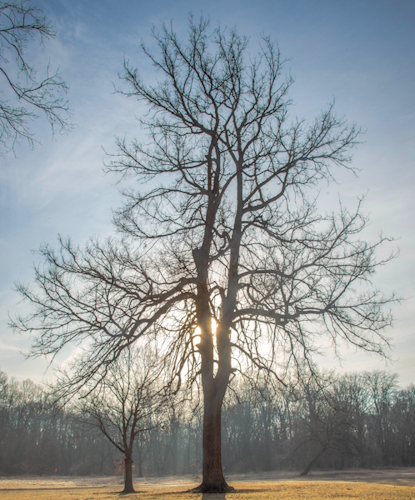
Natural Land Institute’s (NLI) Legacy Tree Program is pleased to recognize a Rock Elm (Ulmus thomasii) as the 2026 March Tree of the Month. It is located in Hononegah Forest Preserve, 80 Hononegah Road, Rockton, IL 61072 – Forest Preserves of Winnebago County’s first Preserve, established in 1924. This Rock Elm is 62.0 feet high, and has an average crown spread of 57.0 feet, and a circumference of 100.48 inches (8.37 feet).
This is an uncommon and State endangered tree species and, due to its size, was noticeable. NLI nominated it to the Illinois Big Tree Register. It was confirmed as the Illinois State Champion after being measured last November, by the Register’s official Justin Vozzo, Extension Specialist in Forestry, University of Illinois Urbana-Champaign.
The Rock Elm at Hononegah Forest Preserve was nominated by Mike Brien, Director of Natural Resources, Forest Preserves of Winnebago County. He said, “Rock Elm in Illinois is a very uncommon species, as evidenced by its listing as a State Endangered Species. Honegah Forest Preserve is the only natural area in the State where I have seen them. Simply having any individuals of the species left in our preserves is notable. Having not only the largest REock elm in the State, but many juvenile specimens as well, is truly special.”
Say the word elm, and most older people (those 60 and older) envision the large shade trees that once lined the streets of nearly all Midwestern cities and towns. These were mostly American Elms. Few people know that two other species of native elm (Slippery or Red Elm and Rock Elm) were also found in the Upper Midwest. Dutch Elm Disease killed off nearly all of these formerly iconic trees by the 1970s, but a few have survived. This Rock Elm is one such survivor.
Rock Elm has always been fairly uncommon. It grows only in gravelly or rocky soils on floodplain terraces of creeks and rivers or along the rocky bases of bluffs. Rock Elm can most easily be identified by how it grows – usually with a strong upright form with a skirt of branches–most often the lower, smaller branches have ridges of cork–but that is not the case with this tree.
The leaves are classic elm shape, simple with serrated edges, and the seeds are what are called samaras–little, papery wafers with a seed in the middle that is usually visible. They are green on the tree until they ripen paper brown and blow off the tree, carried by the wind a considerable distance. Elms bloom in March with tiny flowers that are little noticed. Aldo Leopold wrote about them looking like a ruddy haze on the tree. The seeds ripen in spring and are relished by all sorts of creatures, from songbirds to squirrels, as one of the first snacks of the season.
Rock Elm is on the Endangered Species plant list in Illinois. This tree, although not huge, is the largest remaining individual known in the State. It is the official State Champion!
Alan Branhagen, NLI’s Executive Director, said, “I grew up with the tree in my neighborhood in Decorah, IA–as a boy who always noticed trees. It grew differently and had larger seeds than the common American Elm, while not having the raspy Ruffles potato chip leaves of Slippery Elm (named for its slippery under-bark.)
“All the American Elms and Slippery Elms in my neighborhood’s streets are now gone, but three Rock Elms are still there, surviving just like this tree in Hononegah Forest Preserve. I do remember Hononegah having a few large Rock Elms when I worked for the Forest Preserves of Winnebago County in the late 1980s and 1990s. Today there is just one other maturing tree and some saplings. We are grateful they can be protected.”
This Rock Elm is growing well but does show past dieback caused by recent droughts or a combination of factors.
“It appears to be recovering, and we hope it continues to spread its seeds at Hononegah Forest Preserve. We thought this was the last known population of Rock Elms in Winnebago County, but we recently discovered a new population at Oak Ridge Forest Preserve,” said Branhagen.