
A grand Pin Oak (Quercus palustris) tree located at Specialty Screw Corporation, 2801 Huffman Boulevard, Rockford, lL, was featured as the August Tree of the Month, through Natural Land Institute’s (NLI) Legacy Tree Program. The Pin Oak is 59.5 ft. high, has an average crown spread of 80 ft., and measures a circumference of 121 in. (10.08 feet.)
Russ Johansson, nominator of the tree and President and Chairman of Specialty Screw Corp., said, “This tree was likely planted around 1965 when the property was developed for Time Screw, a 45,000 sq. ft. fastener manufacturing facility.” One of the owners at that time, Les Pearson, “had a fondness for landscaping,” said Johansson. “When traveling on Glenwood Drive you end at Huffman Boulevard and notice the grandeur of the Pin Oak.” The property was purchased in 1979 by Specialty Screw. With the help of Mark’s Tree Service, they have continued to maintain this and other trees on the property.
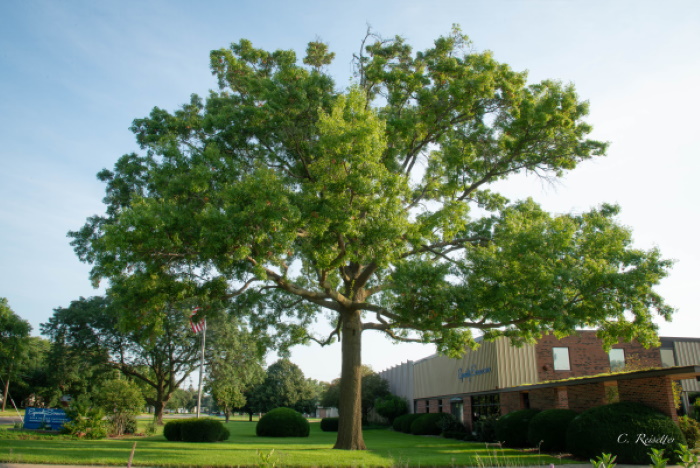
“The Pin Oak is a fine specimen of what nature has to offer; a cycle of life when it is dormant in the winter and springing forth with new growth of spring green, maturing during the summer to provide food and cover of leaves for the winter dwellers,” said Johansson.
Pin Oak was a very popular landscape tree starting in the middle of the 20th Century. It is uniquely easy to transplant for an oak and displays a lovely pyramidal crown when young. Pin Oaks also grow decidedly fast, yet are sturdy and long-lived.
They are very valuable trees in the landscape because of their high ecosystem services. They provide beauty with their often-red color in late fall and support a plethora of beneficial insects. Their mass of acorns is a premier food for all sorts of wildlife. These acorns are small and readily consumed by all sorts of creatures–from songbirds to squirrels. The tree’s preferred habitat in the wild is floodplain terraces and wetlands, or soils that can be wet because of a hardpan underneath.
“Pin Oaks were not native to the immediate Rockford region when the first Euro-settlers homesteaded,” said Alan Branhagen, NLI’s Executive Director. “The tree’s range is just a bit south where they were recorded on the original land surveys in Lee County in sandier soils. The tree actually prefers more acidic soil, so the limestone and glacial gravel-based soils of much of the immediate region were not necessarily to its liking.” He added it often suffers a leaf chlorosis (yellowing) in gravelly or “limey” (higher pH) soils. This appears to be less of a problem lately, possibly due to the effects of acid rain and other climate change factors. “Do not plant this tree in gravelly soils,” he stated.
Pin Oaks that were first planted last century are now maturing–their crown of limbs changes from pyramidal to rounded at maturity. The trees can grow to be enormous: 100 feet tall and wide. None are that large locally, but in time, they should reach that stature. Our legacy tree has transformed into the mature, rounded crown stage, but it should be around for a long time!
Pin Oaks offer climate resiliency and sequester a lot of carbon quickly in their wood. They are heat- and drought-tolerant owing to their more southerly range. The tree’s adaptation to flooded conditions is equivalent to a drought if you understand how a tree’s roots absorb moisture through osmosis. Floodplains are also where silt and sand can be dumped, as water channels change, and why most floodplain trees thrive in our urban-disturbed soils–including pavement–over their roots.